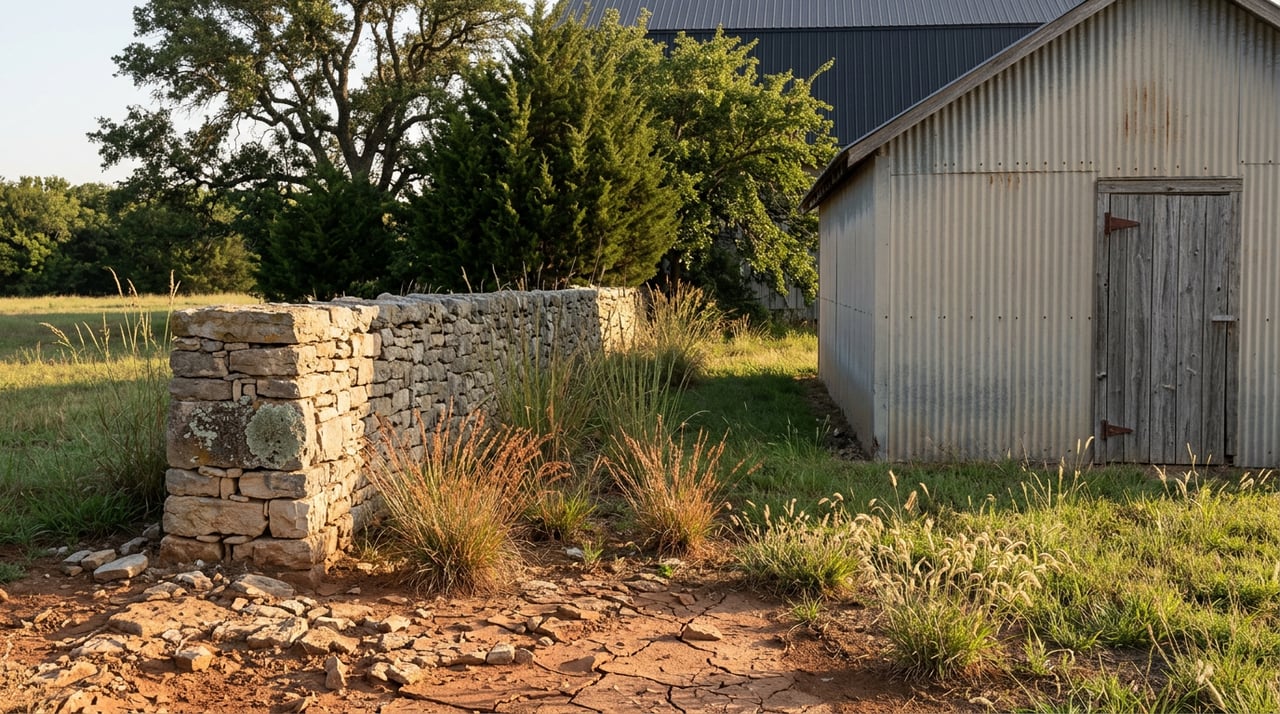
A buyer walks 40 acres outside Pauls Valley, likes the pond, likes the fence lines, likes the price, and signs. What they often don't ask is whether they're buying the dirt or the dirt and everything under it. In Oklahoma, those can be two separate pieces of property with two separate owners, as Eckard Enterprises explains, and the standard real estate contract, as the Oklahoma Real Estate Commission's 2026 Farm, Ranch and Rec form shows, is written to protect the seller's right to have already carved one away from the other.
That's the part of a Garvin County land deal that catches people off guard. Not the price. Not the survey. The minerals.
Two Kinds of Property in the Same Ground
Oklahoma law treats mineral rights, meaning oil, gas, and other subsurface resources, as real property distinct from the surface itself. A landowner can sell the surface and keep the minerals, sell the minerals and keep the surface, or split the minerals again among heirs until a single 80-acre tract has a dozen fractional owners who've never met each other.
There are three configurations a title search can turn up. A unified estate means one owner holds both surface and minerals, which is the simplest case and the one most buyers assume they're getting. A split estate means the two have been severed, so the mineral rights may not transfer with the sale at all, regardless of what the buyer expected. A fractional estate means the minerals are divided among multiple owners, sometimes going back generations through inheritance nobody bothered to consolidate.
None of this shows up when you drive the property. It shows up in the county clerk's deed books, and it's the reason a rural land sale in Garvin County needs a different kind of scrutiny than a subdivision lot in town.
What the 2026 Oklahoma Contract Actually Says
The Oklahoma Real Estate Commission's contract forms, effective January 1, 2026, spell this out in the title section. Under the Farm, Ranch and Rec Sale contract and the Residential Sale contract alike, the buyer agrees to accept title subject to a short list of standing exceptions: utility easements, building restrictions, setback lines, zoning, and reserved or severed mineral rights. That last category is grouped with the others as something that does not count as a defect in marketable title.
In plain terms, if the seller or a prior owner already carved out the minerals before you ever made an offer, that's not a problem the contract requires anyone to fix before closing. It's baked in as an accepted condition of the sale unless the buyer negotiates something different in writing before signing.
That single clause is why "I bought the land" and "I own everything under the land" are not the same sentence in Oklahoma, and why a buyer who wants both needs to ask the question early rather than assume the answer.
Questions Worth Asking Before You Sign
For anyone under contract or about to write an offer on acreage near Pauls Valley, these are the practical checks that matter more than the listing description:
- Does the seller currently hold both surface and mineral rights, or were minerals severed at some point in the chain of title?
- If minerals were severed, who holds them now, and is there an active oil and gas lease on the property?
- Is the seller offering to convey any mineral interest they do hold, or excluding it entirely?
- Has anyone run a search at the Garvin County Clerk's office using the property's legal description, not just the street address?
A buyer's agent or attorney can raise these before earnest money changes hands.
Where the Answer Actually Lives
Mineral ownership in Oklahoma is public record, but it's filed by legal description, not by address. The state uses the Public Land Survey System, breaking land into sections, townships, and ranges, so a title search starts with that description rather than a mailing address.
The Garvin County Clerk's office, at 201 W. Grant, 2nd floor, in Pauls Valley, maintains the deed books, probate files, and mineral conveyances for the county. Records can also be searched online through OKCountyRecords.com, which hosts digitized land records for Garvin and 65 other Oklahoma counties, with a legal search option that pulls every recorded instrument tied to a specific tract regardless of who filed it.
| Task | Where it happens | What it costs |
|---|---|---|
| Standard document copies | Garvin County Clerk's office | LegalClarity reports $1 per page |
| Recording a new deed | Garvin County Clerk's office | $8 first page, $2 each additional page |
| Full mineral title search on a complicated tract | Landman or oil and gas attorney | Varies by chain complexity |
A single tract with a short, uncontested chain of title is often something a buyer or their agent can research directly. Once probate files, multiple heirs, or decades-old severance deeds enter the picture, a landman who does this professionally saves far more time than a weekend at the courthouse.
The Fifteen-Year Clock Nobody Mentions
Here's the part that surprises people who assume unused mineral rights eventually just fold back into the surface. They don't, at least not automatically. Under Oklahoma law, if royalty proceeds on a mineral interest go unclaimed for fifteen years, the state can subject that interest to judicial sale. But the mineral rights themselves don't revert to the surface owner through escheat. Ownership stays wherever the last valid deed put it until someone claims it or the state processes it separately.
That matters for two reasons. First, if you're the buyer who didn't get the minerals, there's no waiting period after which they become yours by default. Second, if drilling ever happens on land where the mineral owner can't be located, Oklahoma's forced pooling rules still guarantee that owner their proportionate share of production, calculated as acres owned divided by gross acres in the unit. The operator can't simply redraw the boundaries to exclude someone whose address went stale. Anyone who does end up holding mineral rights, whether through this purchase or an inheritance, can keep their contact information current through the state's mineral owner resources so a check doesn't end up sitting unclaimed.
A conversation on a mineral rights forum from a buyer working a five-acre parcel in nearby Grady County captured the confusion well: the paperwork never mentioned minerals at all, and the buyer wasn't sure if silence meant inclusion. The story is a reminder to check the title and deed before assuming mineral rights are included.
A Boundary Survey Won't Answer This
It's worth separating two things buyers sometimes lump together. A boundary survey tells you where your fence lines actually sit relative to the legal description, which matters plenty for acreage with old or informal fencing. A typical residential boundary survey in Oklahoma runs $500 to $2,000, with rural acreage and more complex parcels running higher, and takes one to four weeks depending on how much records research the surveyor has to do.
None of that touches mineral ownership. A clean survey and a clean mineral title are two different clearances, done by two different professionals, and a buyer who orders one assuming it covers the other will find out the gap the hard way, usually when a landman shows up wanting to lease something the buyer thought they already owned.
Quick Questions Before You Sign
Does buying land in Oklahoma automatically include the minerals underneath it? Only if the estate is unified and the deed conveys both. If a prior owner severed the minerals at any point, they stay separate unless the current deed specifically includes them.
Can I still build, farm, or run cattle on land where I don't own the minerals? Oklahoma law gives mineral owners a right to reasonable access if they ever develop.
What if the mineral owner wants to drill after I've closed? They have that right if minerals are severed, subject to Oklahoma Corporation Commission rules and any existing lease. It's a real possibility worth knowing about before you buy, not after.
Rural land near Pauls Valley rewards buyers who ask about what's under the ground as carefully as they ask about what's on it. That's the kind of detail an ALC-credentialed agent who works farm and ranch transactions every week catches before it becomes a surprise at the closing table. If you're evaluating acreage in Garvin County and want someone who reads the mineral rights line before you sign, Cross C Realty can walk the property and the paperwork with you. Get Your Free Market Report to start with the numbers, then let's talk about what's underneath them.
This article is general information, not legal, tax or financial advice. Consult a qualified professional about your situation.